Curriculum
With Yujia, I co-designed the full curriculum: how concepts are introduced, explored, connected, and applied.
A guided learning experience that brings soft and compliant mechanisms off the screen—and into people’s hands.

My contribution
With Yujia, I co-designed the full curriculum: how concepts are introduced, explored, connected, and applied.
I designed the final learning boards—the iPad screens that guide learners through the activities.
With Yujia, I analyzed the user-study data to understand learning outcomes and how participants approached the tasks.
Team context: Feel2Know combines physical structures and a digital curriculum. The 3D blocks were designed by other team members, not by me.
The design question
Bending a flexible object reveals resistance and motion immediately. But that sensation alone does not explain which geometric or material property caused it.
Our challenge was to connect physical exploration to a repeatable reasoning process, rather than leave learners with an interesting demonstration.
20 interactive screens · Three concepts
Bending stiffness, degrees of freedom, and material behavior each follow the same four-stage cycle. Here is how it unfolds in the bending-stiffness module.
Define
Introduce bending stiffness through familiar examples and a short classification task, establishing vocabulary before physical exploration.
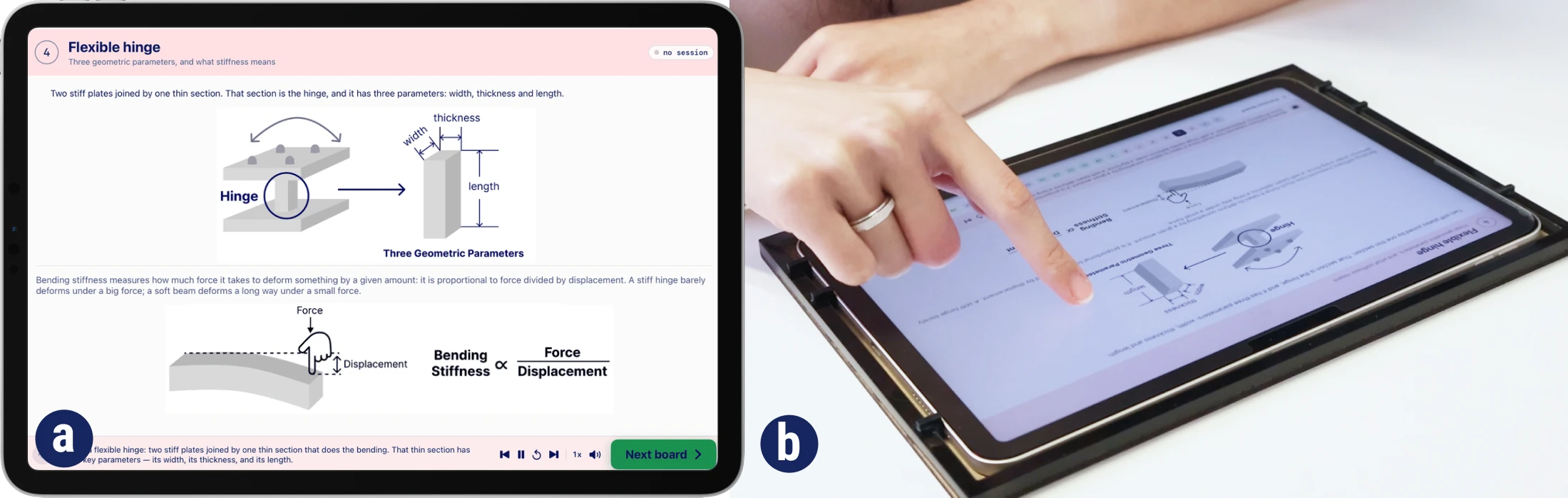
Explore
Compare hinges that vary in width, thickness, or length while other variables stay fixed. Learners connect what they feel to a graph, then reconsider their answer with feedback.
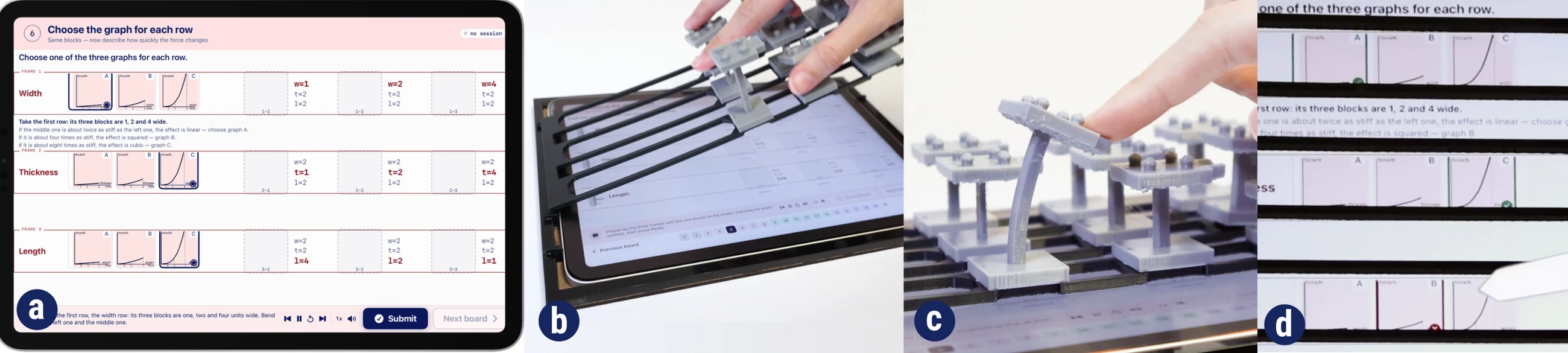
Generalize
Bring physical comparisons back to a visual and mathematical explanation: thickness and length affect stiffness differently from width.
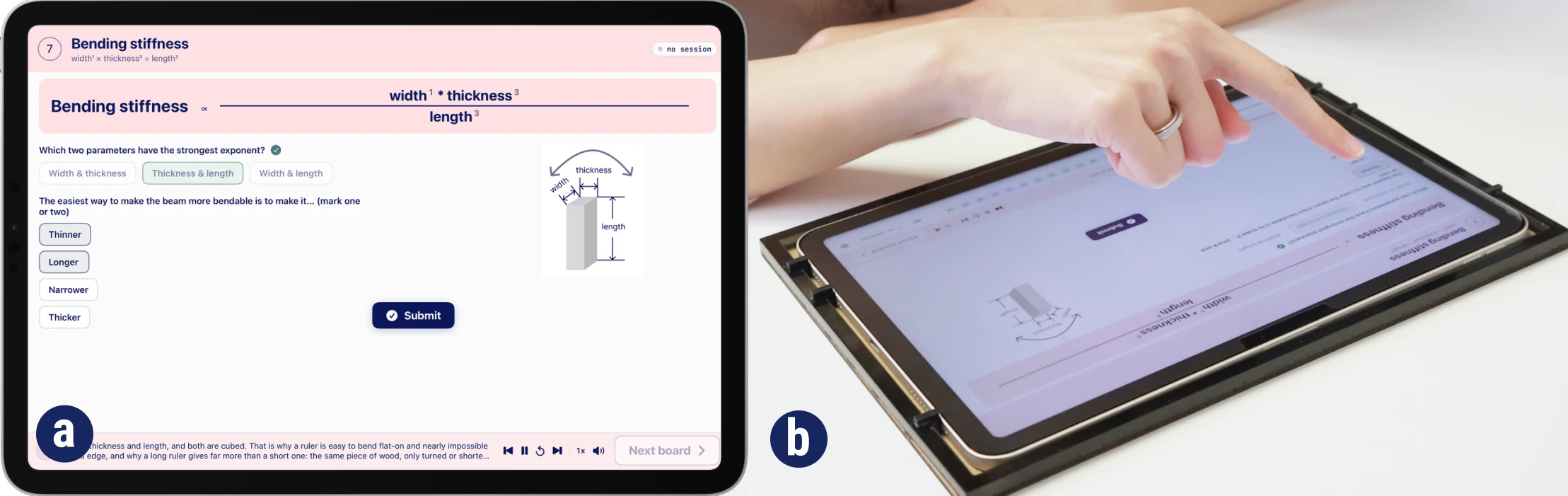
Apply
Choose and stack five blocks, thread a cord, and pull to test a target bending sequence. Feedback identifies what needs to change without giving away the exact block to use.
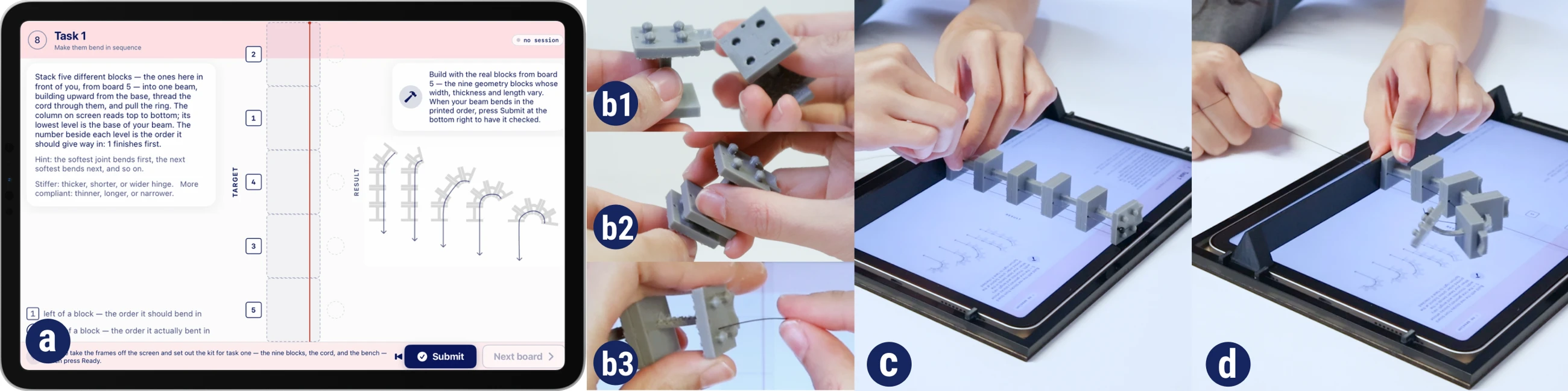
Learning-board and activity figures from the submitted manuscript. Feedback combines guided explanations and hints; construction-task correctness was marked by a researcher, not automatically sensed.
Refining the experience
The curriculum introduced degrees of freedom before range of motion, separating what movement is possible from how far something can move.
Moving feedback behind a submit action gave learners a moment to make their own judgment before seeing the response.
Iterations tightened the relationship between earlier comparisons and the final construction challenge, asking learners to use a principle in a new configuration.
Evaluating the curriculum
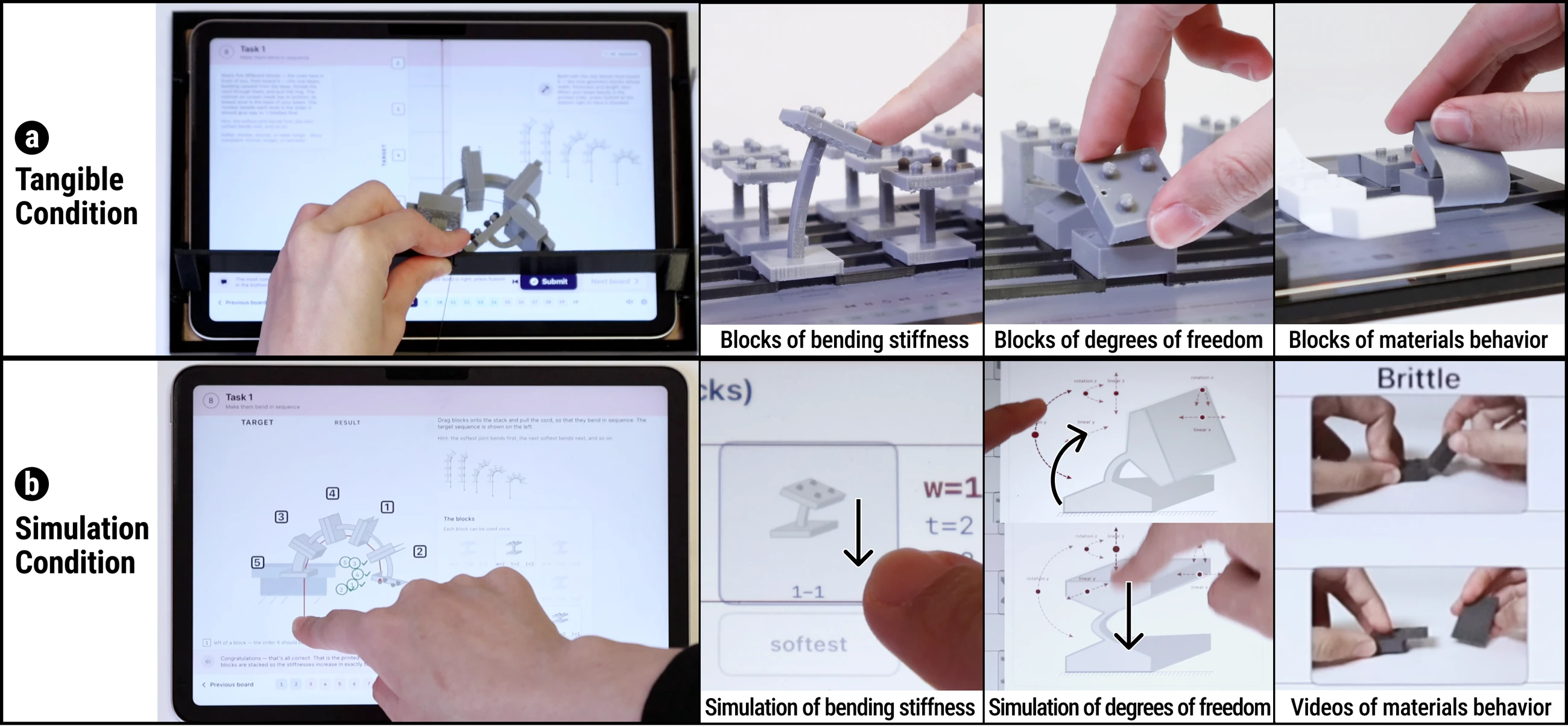
Thirty adults were randomly assigned to tangible or interactive-simulation conditions, with 15 in each. Both used the same 20-screen curriculum, learning goals, questions, narration, and feedback.
Mean test score · Out of 10
A 10-item pre/post assessment showed a larger improvement in the tangible condition (group × time interaction, p = .027).
Tangible participants completed all four application tasks with fewer attempts, suggesting a more direct path from exploration to revision.
10 of 15 tangible participants described using physical resistance or movement limits to reason about the mechanisms.
6 of 15 tangible participants said touch alone was not enough. Diagrams and equations remained important to understanding.
Design takeaway
For me, the central design work was connecting an action to a question, a question to an explanation, and an explanation to the next attempt. Physical, visual, and symbolic representations work best as complements—not replacements.
Research source: Feel2Know: Learning Soft and Compliant Mechanisms Through Tangible Interaction, submitted to CHI 2027. Process details are drawn from the team’s project documentation.
Explore all work ↗