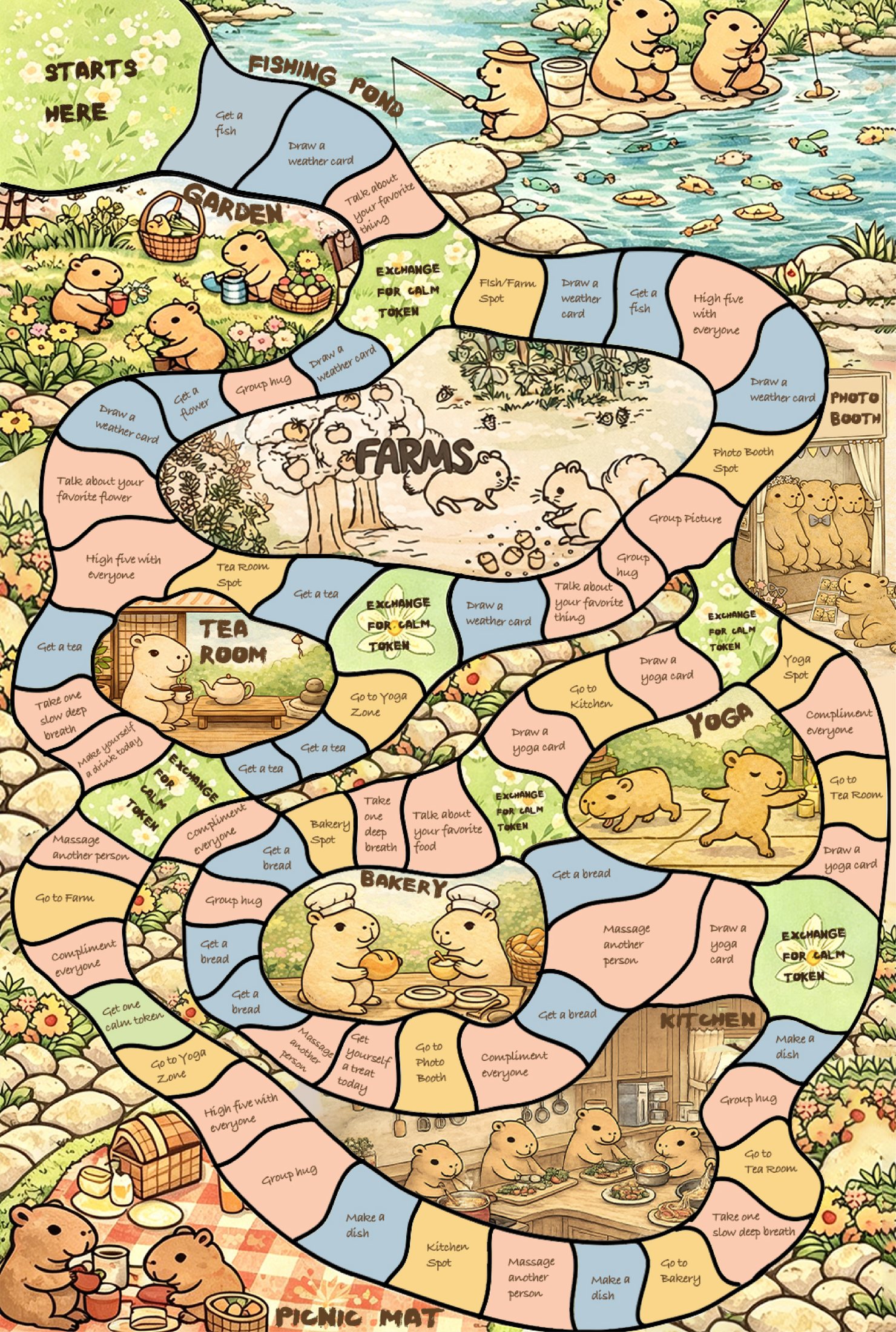
Designed the overall map layout, positioned each thematic zone, and wrote the interaction and content for every board space.
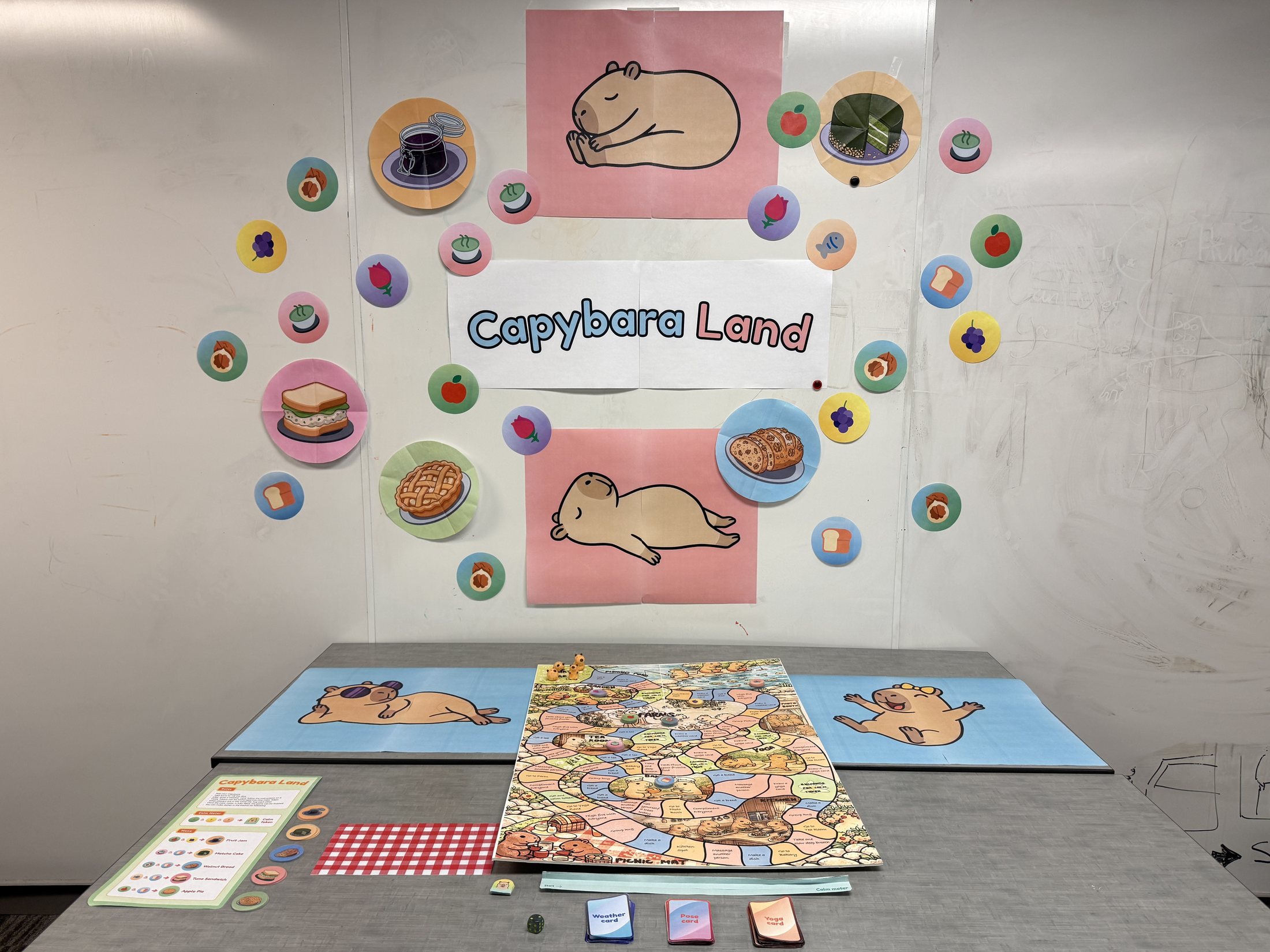
Team project · Carnegie Mellon · Persuasive Design
Capybara
Land
A cooperative game that makes small calming actions easier to start.
- My ownership
- Map system · core rules · handmade player pieces
- Scope
- Behavioral strategy · game mechanics · prototyping · playtesting
- Team
- Sue Hong · Yazmin Wang · Gabriella Chen · Jan Chen
- Status
- Completed academic prototype · refined through qualitative playtesting
My contribution
I designed the board players move through and the rules that keep everyone on the same side.
Within the four-person team, my ownership connected the spatial journey, the game economy, and the tactile player experience.
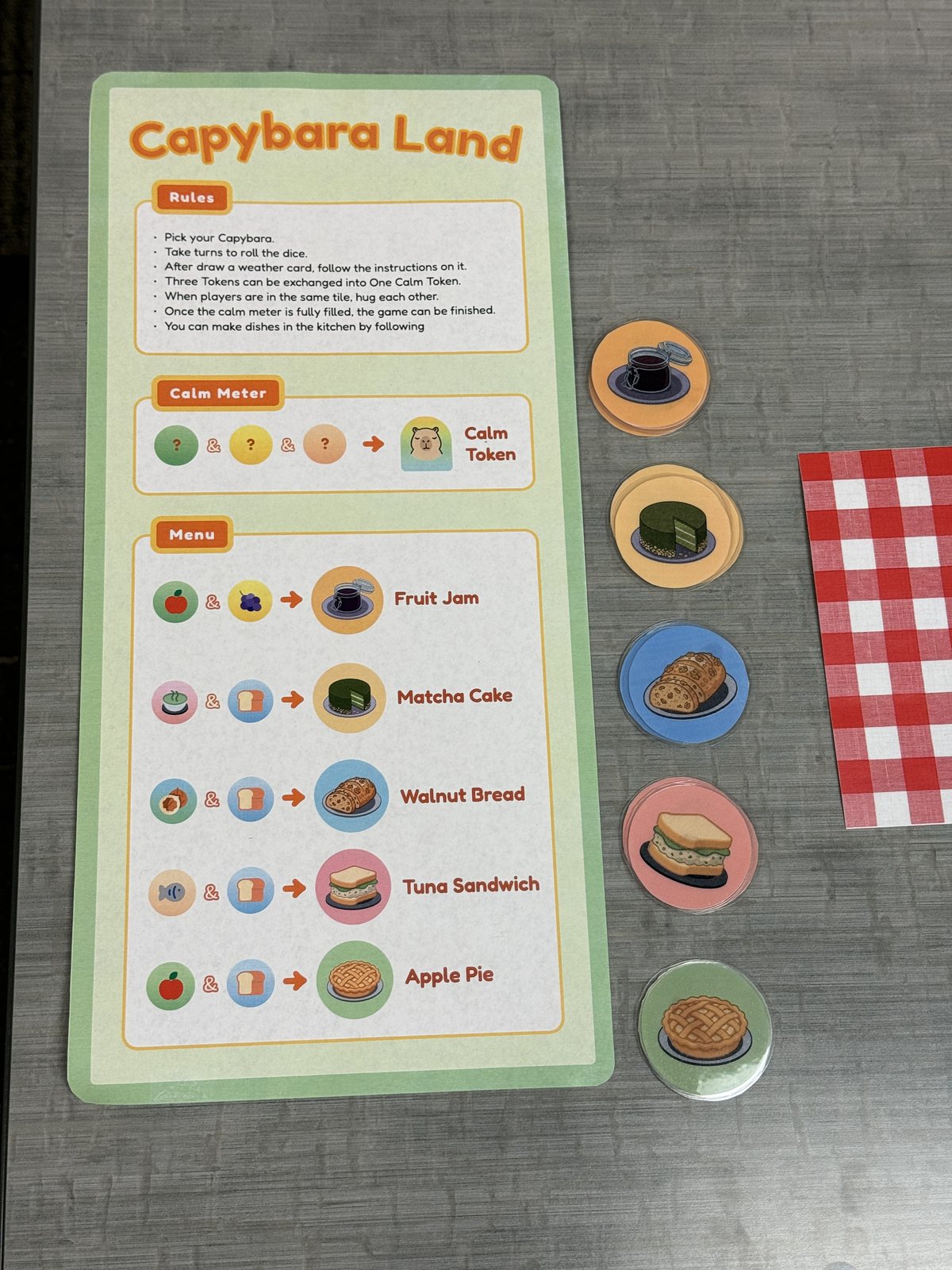
Defined the team Calm Meter and a two-path food system: exchange food for shared calm, or keep it to build the group picnic at the end.
Positioned the game around collective progress instead of individual scores, rankings, or a single winner.
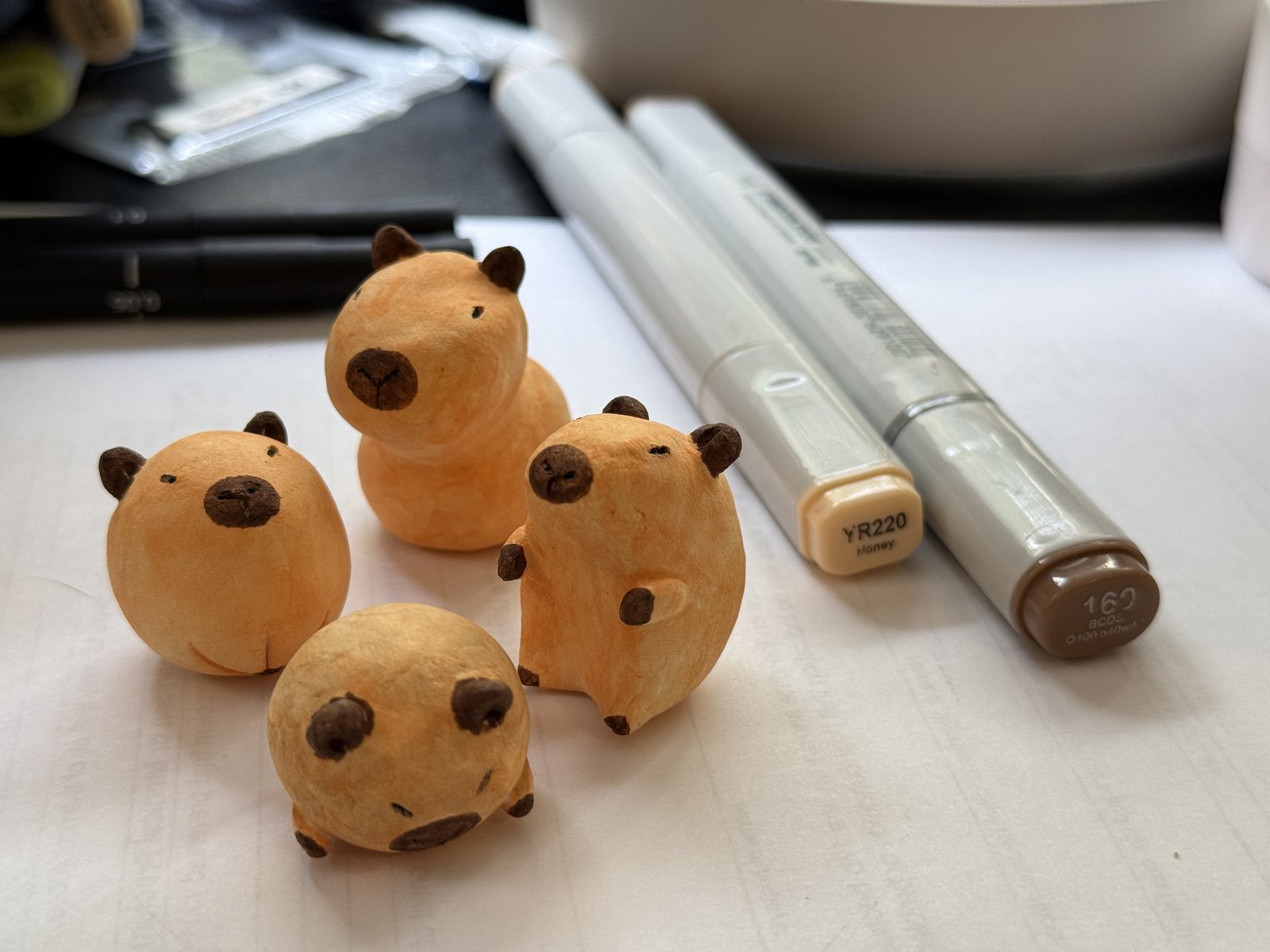
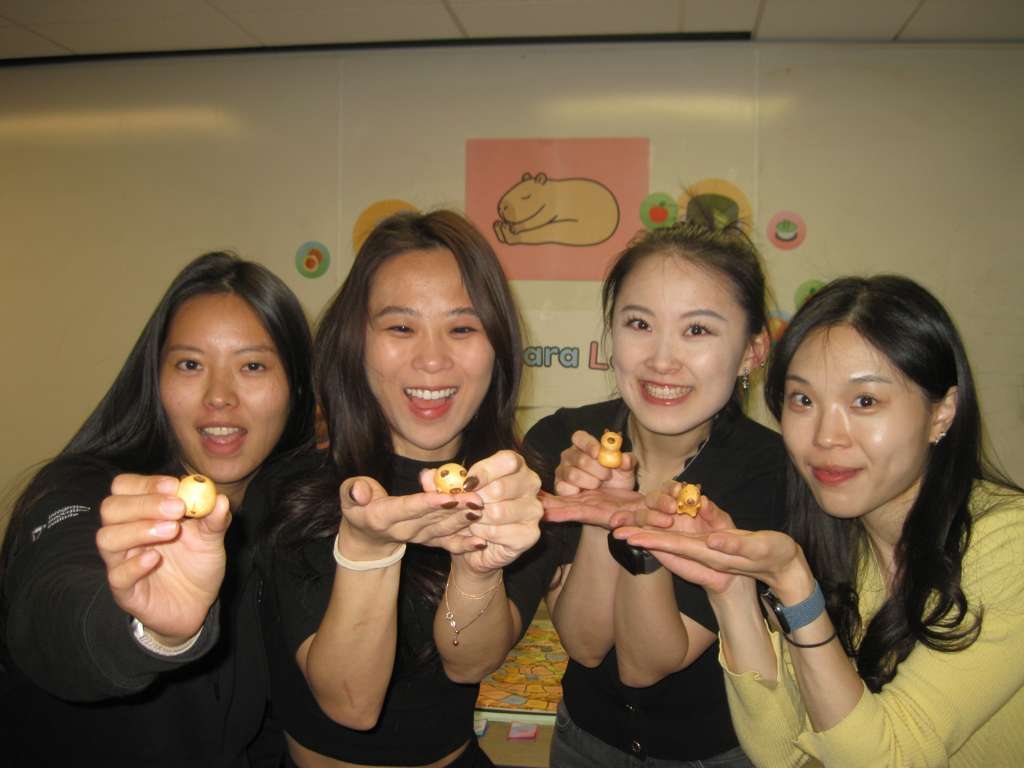
Handmade the capybara tokens that represent each player and make the shared world tactile.
01 · The tension
When relaxation feels like work, people resist the invitation.
Digital wellness can ask stressed people to return to the same screens contributing to burnout. Explicitly telling someone to “relax” can also turn self-care into another obligation.
How might a physical, social experience make small calming behaviors easier to begin, without pressure, ranking, or self-disclosure?
02 · The game in one turn
One journey.
One shared measure of progress.
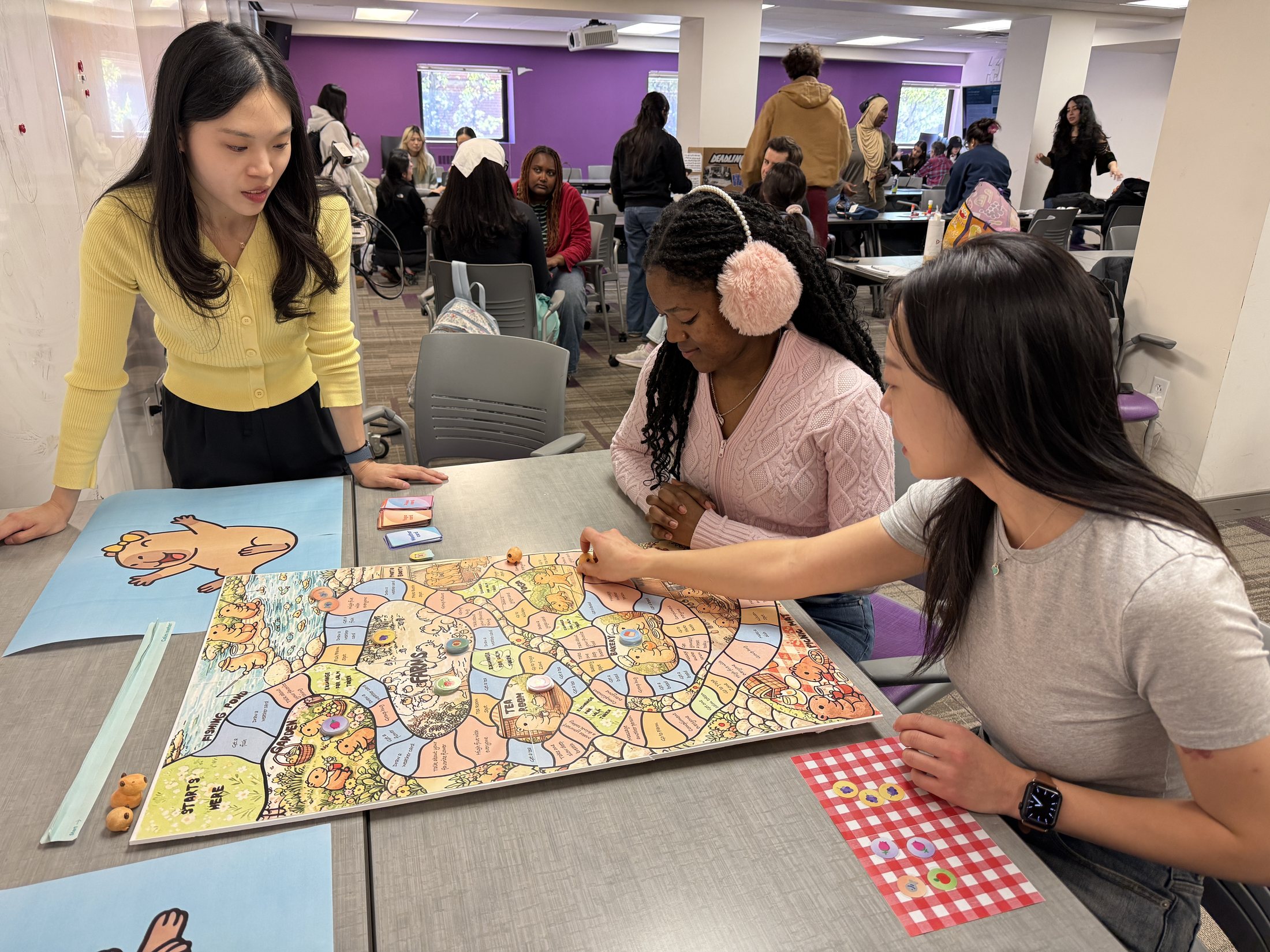
Players explore at their own pace. Each turn connects a small action to a visible, collective goal instead of an individual score.
Choose
Pick a tactile capybara piece.
Explore
Move through six activity zones.
Participate
Draw a prompt or complete a small action.
Gather
Collect ingredients and create a meal.
Contribute
Exchange tokens to fill one shared Calm Meter.
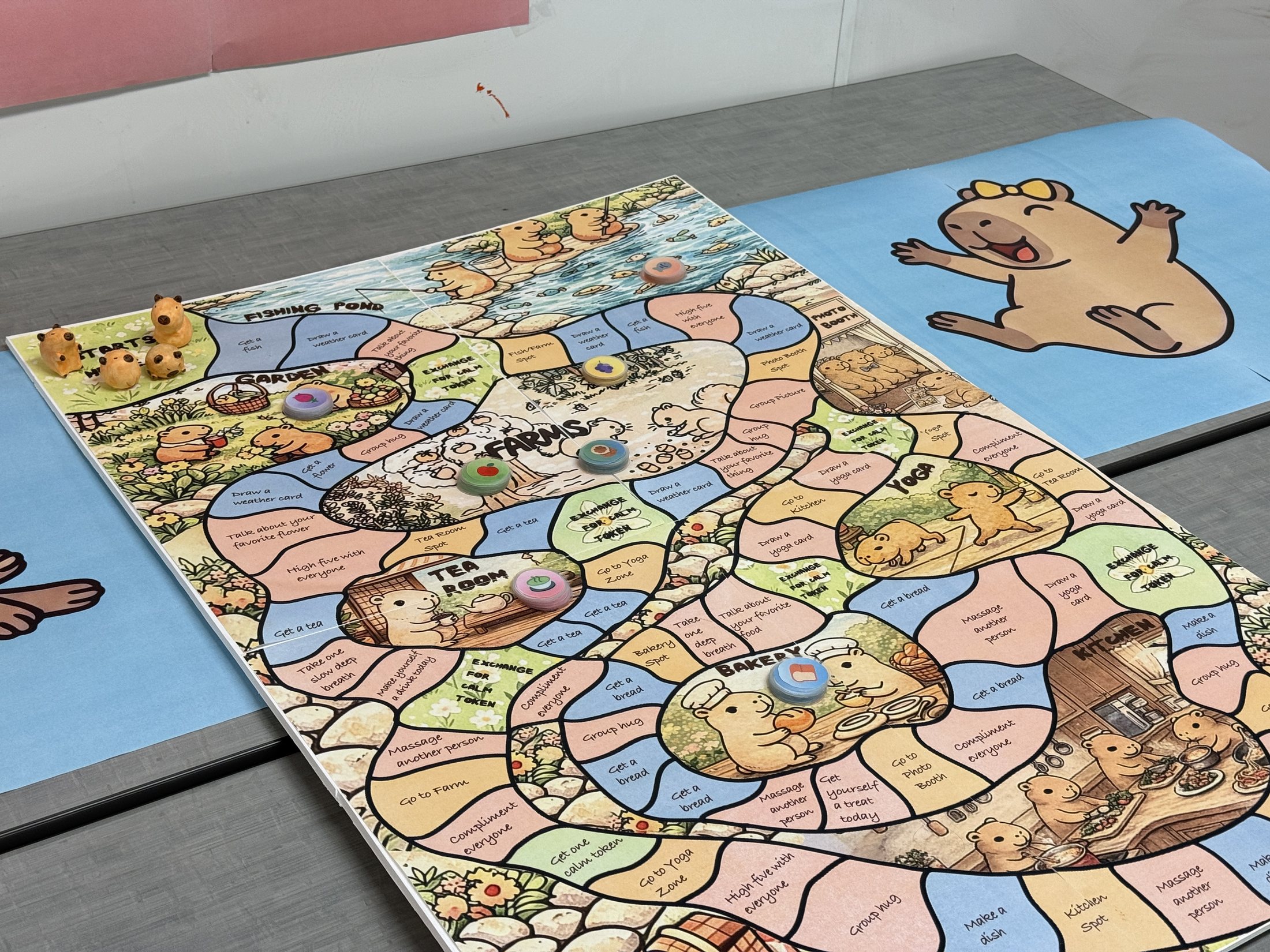
Different zones mix social, physical, and reflective interactions across one continuous route.
03 · Mechanics with intent
The system does the persuading.
Three design moves translate behavioral principles into what people see, touch, and do. The academic theory stays behind the experience; the invitation stays simple.
01Prime
Set the mood before the rules begin.
Soft color, rounded illustration, cozy locations, and handmade pieces make the invitation feel gentle before anyone draws a card.
02Embed
Hide self-care inside ordinary play.
Breathing, stretching, reflection, and small social actions are woven into movement, characters, cards, and collecting.
03Cooperate
Replace individual scores with shared progress.
Every player contributes to one Calm Meter, making participation visible without ranking people or rewarding a single winner.
04 · What playtesting changed
Give people time to participate.
The first playable prototype exposed a structural problem: the route worked, but speed and ambiguity pulled attention away from the activities themselves.
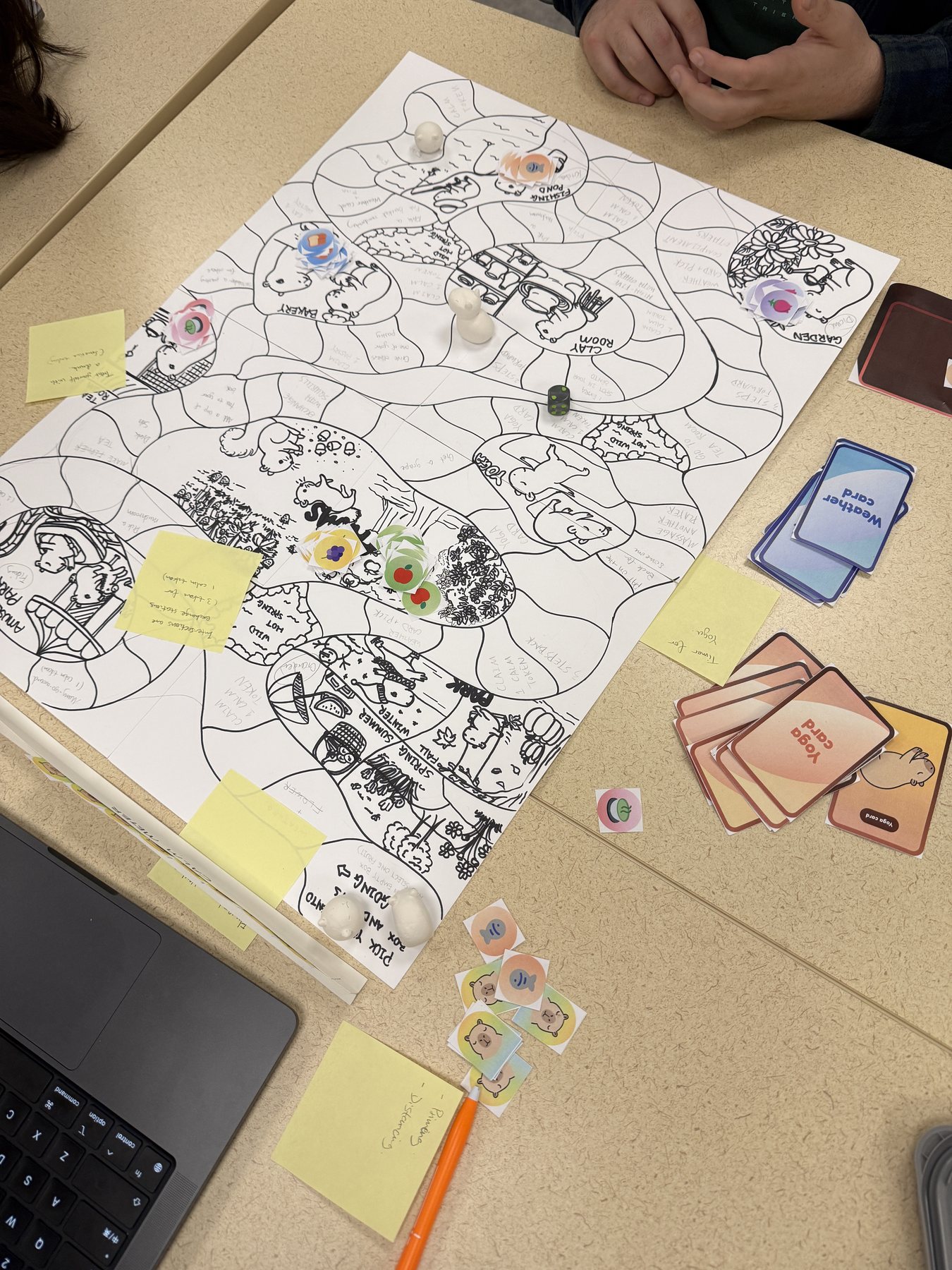
Testing rules, prompts, route clarity, and pace before visual refinement.
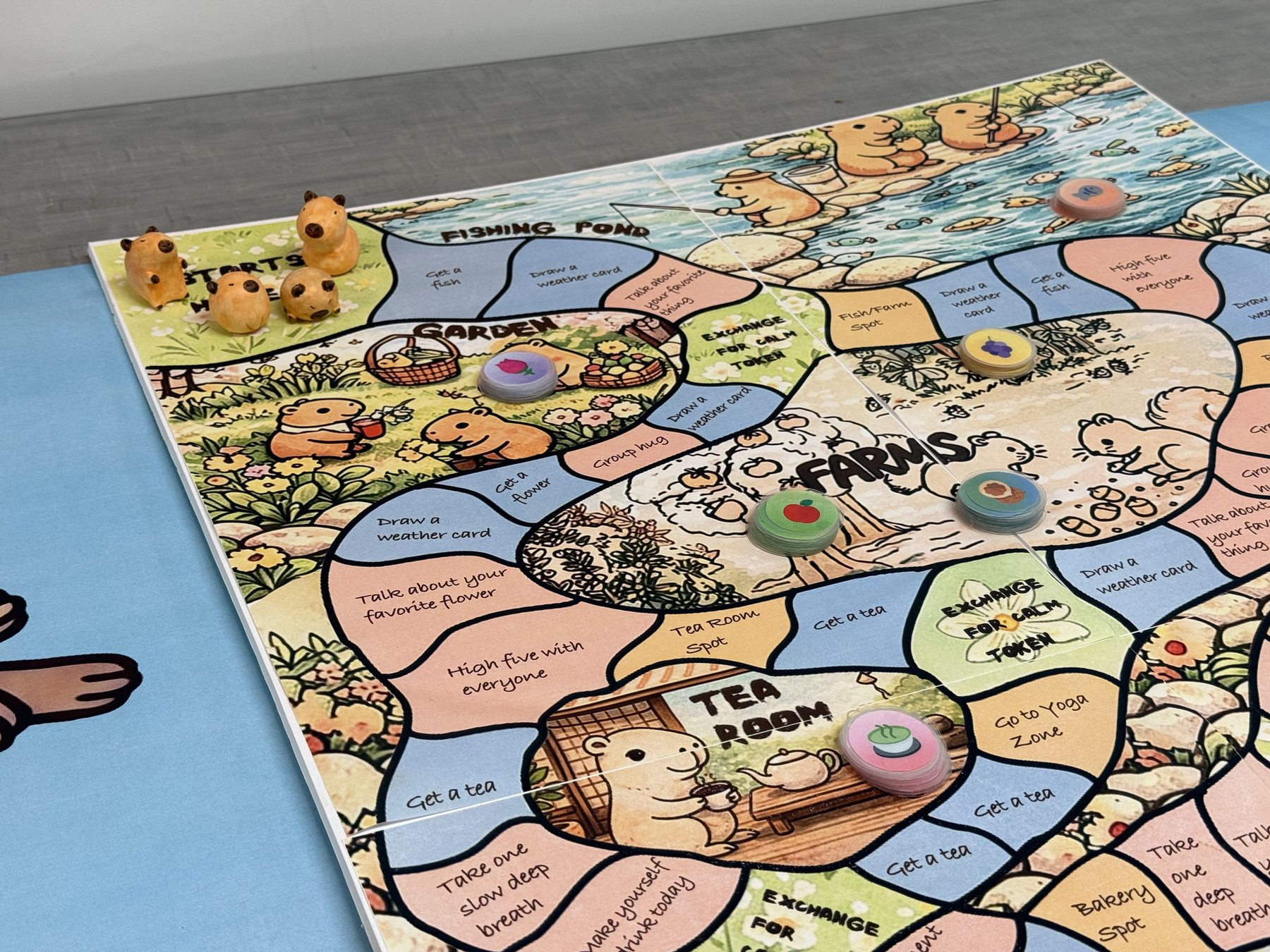
Instructions live on every space; shared progress must be earned through play.
The game moved too quickly.
Observed in the first version
Calm Tokens could be claimed directly, shortening the time spent in activities.
Design response
Players now exchange three regular tokens for one Calm Token, slowing the journey and making shared progress more meaningful.
Some turns felt empty or unclear.
Observed in the first version
Several tiles offered too little direction, leaving players to infer what should happen next.
Design response
Every tile gained a concrete instruction so the board itself could guide the experience.
Physical prompts created the strongest engagement.
Observed in the first version
The first version offered fewer movement-based moments across the route.
Design response
More physical activities were added, and zones were rearranged into a smoother social, physical, and reflective journey.
05 · Final play session
The most valued moments happened between players.
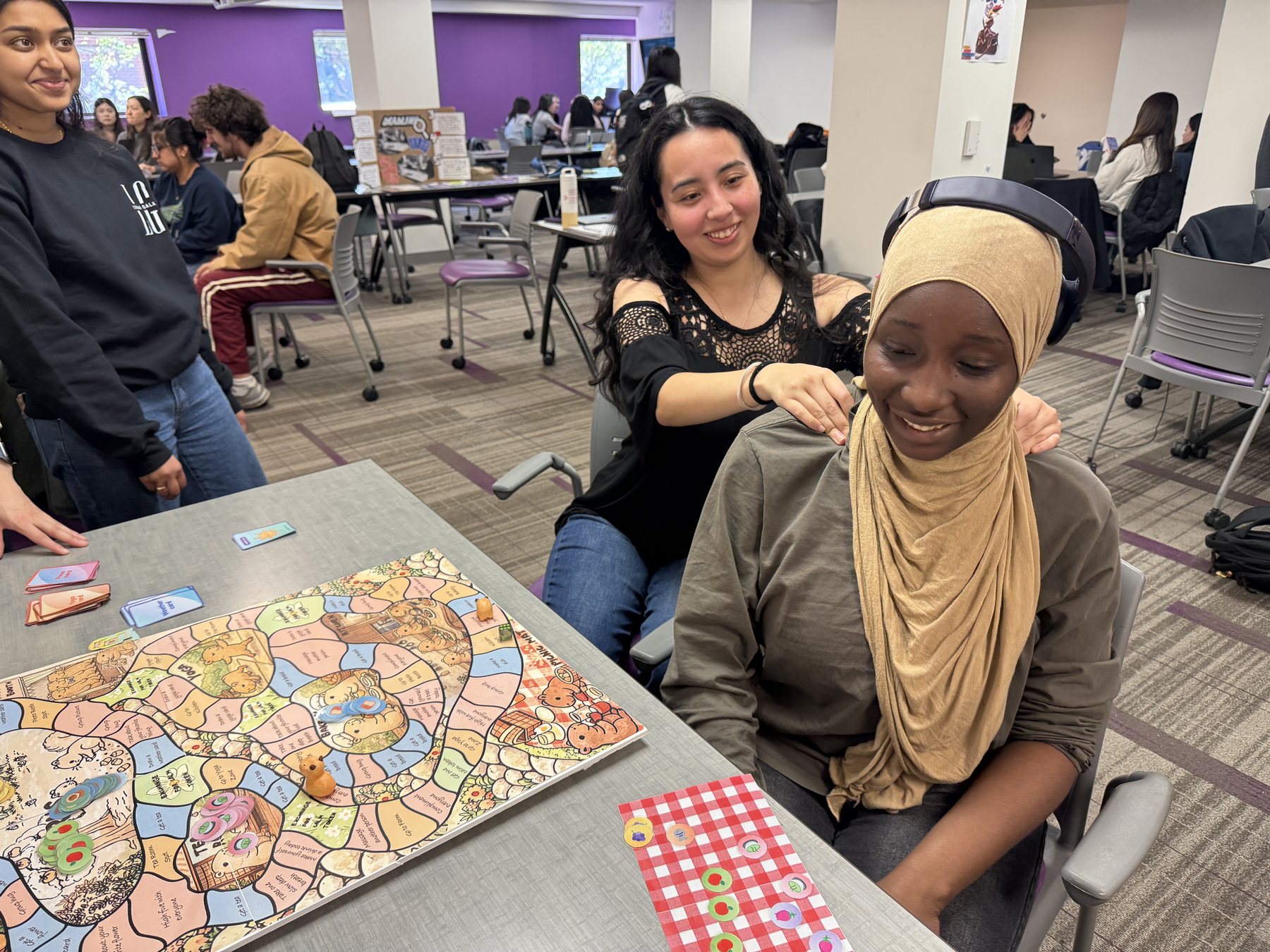
Participants responded most strongly to the physical and social activities. Yoga and other embodied prompts created movement, laughter, and interaction. The final game gives those moments more room.
06 · Outcome & limits
A finished physical prototype, ready for the next round of playtesting.
Capybara Land demonstrates how atmosphere, mechanics, and social structure can work together to lower the barrier to everyday stress-relief behaviors. It does not claim clinical efficacy or measured stress reduction.
An illustrated board, cards, ingredient and meal tokens, handmade figurines, rules, a shared Calm Meter, and a full physical prototype.
Playtesting informed the pacing, tile guidance, zone flow, token economy, and emphasis on physical activity prompts.
Clearer self-guided onboarding, more varied prompts and meal opportunities, and alternatives for people less comfortable with group interaction.
With gratitude
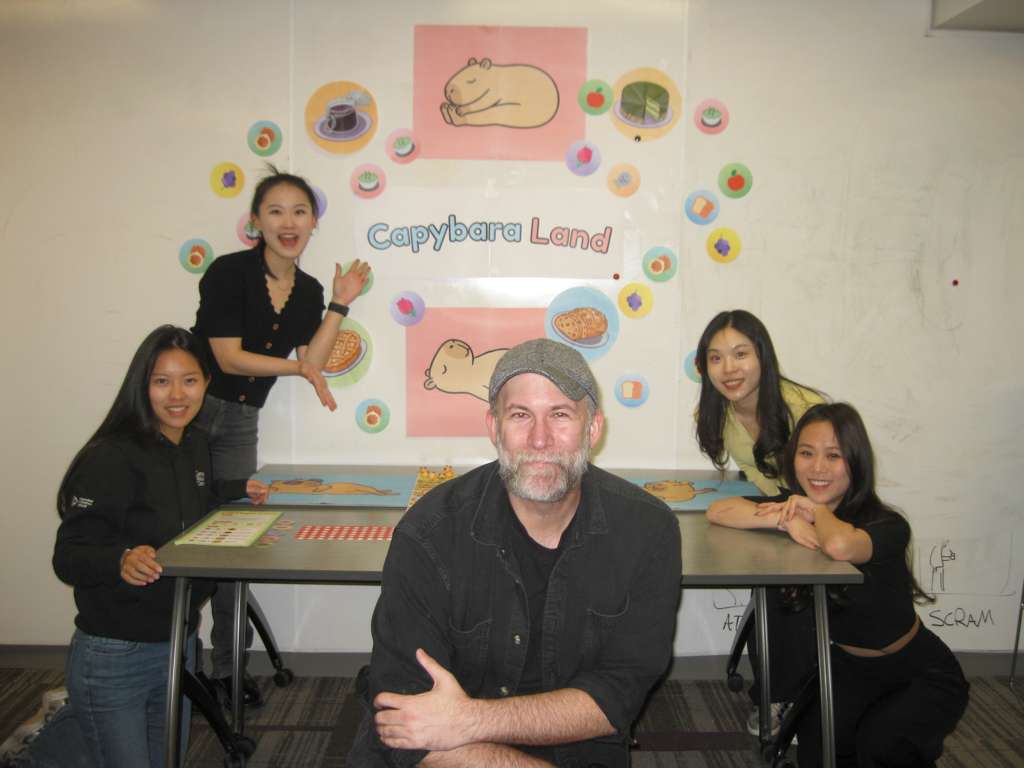
Thank you to Sue Hong, Gabriella Chen, and Jan Chen for shaping Capybara Land together—and to Professor Geoff Kaufman ↗ for guiding the project.
Next case study
Amazon Curio↗